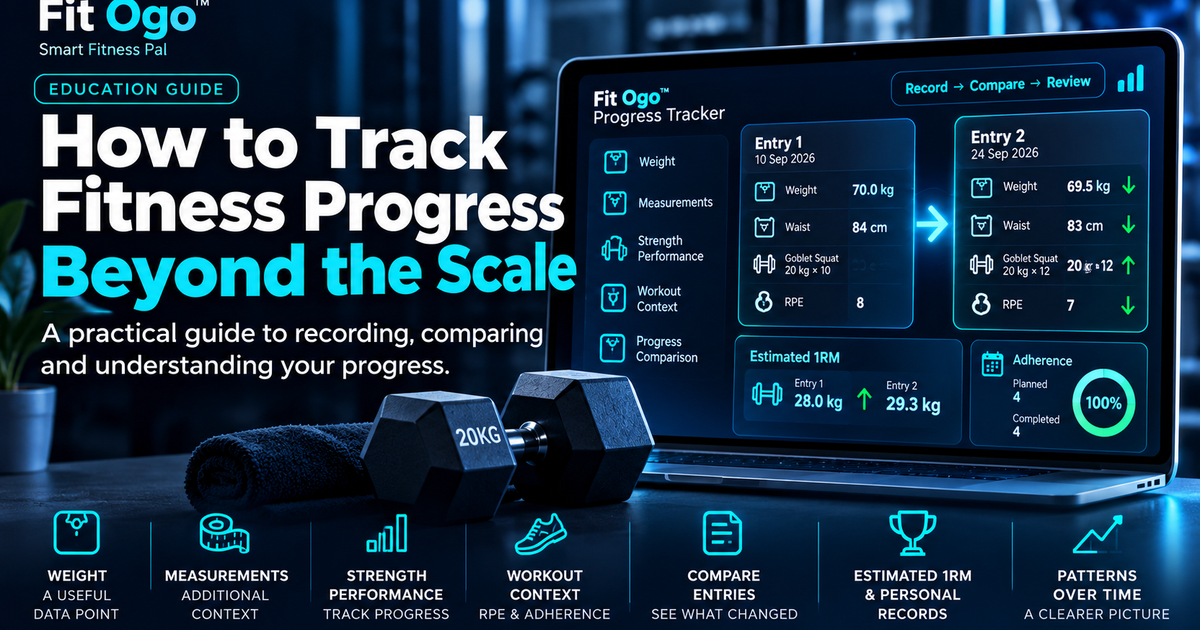
Fitness progress is often reduced to one number on the scale, but scale weight is only one piece of information.
A broader progress record can include body measurements, strength performance, workout effort, completed sessions, adherence, notes, and repeated entries over time.
The goal is not to collect as many numbers as possible. It is to record information that helps you compare one point in time with another and understand what actually changed.
Start With the Information You Can Record Consistently
A progress tracker becomes more useful when the information is recorded in a consistent way.
That does not mean every field has to be completed every time. Choose the information that is relevant to the routine you are following and that you can record reasonably consistently.
- Weight
- Body fat if already known
- Chest, waist, hip, arm, thigh, and neck measurements
- Strength sets
- Workout effort
- Adherence
- Notes
Treat Weight as One Signal, Not the Entire Progress Story
Weight can be useful to record over time, but a change in weight by itself does not explain everything happening in a fitness routine.
It does not automatically tell you whether strength performance changed, whether measurements changed, whether training consistency improved, whether workout effort changed, or why any change occurred.
Weight is best treated as one recorded data point within a broader progress history.
Use Body Measurements for Additional Context
Measurements can provide another way to compare progress over time.
The value is not in a single measurement on one day. The value comes from recording the same type of measurement in a reasonably consistent way and reviewing how it changes across entries.
Avoid drawing large conclusions from very small differences, especially when measurement technique can vary.
- Chest
- Waist
- Hips
- Arms
- Thighs
- Neck
Add Body-Fat Information Only When It Is Meaningful to You
Body-fat information can be included when it is already known or available through a method you choose to use.
Different methods can produce different estimates, so it is important to understand where the number came from and to treat it as tracking information rather than a medical assessment.
A measurement-based body-fat estimate remains an estimate rather than a clinical measurement.
Track Strength Performance With Exercise, Load and Repetitions
Strength progress can be easier to review when the same exercise appears in multiple entries.
A simple strength record may include the exercise, the load used, and the repetitions completed.
A later change in those recorded values does not automatically prove every aspect of strength has improved, but it gives you a clear performance difference to review.
Understand What Estimated 1RM Means
Estimated 1RM means estimated one-repetition maximum.
It is a calculated fitness metric derived from the load and repetitions recorded for a strength set and can provide another comparison point for strength performance over time.
Estimated 1RM is an estimate. It is not a direct one-repetition test, a medical measurement, a guarantee of maximum strength, or proof of a training outcome.
Use Personal Records as Performance Markers
A personal record can help identify when a supported strength-performance value exceeds a previous recorded result.
It should still be treated as a performance marker within the recorded data, not a judgement about overall fitness or health.
Add Workout Effort for Context
Two workouts can look similar on paper but feel very different.
Session RPE, or Rate of Perceived Exertion, can provide useful context about how demanding a session felt.
RPE should not be interpreted in isolation. The purpose is to add context to the progress record.
Track Adherence Alongside Performance
Performance is only one part of a fitness routine. It can also be useful to record workouts planned and workouts completed.
From those values, adherence can be calculated. This helps answer a different question: did the routine actually happen as planned?
Use Notes to Preserve Useful Context
Numbers do not always explain the circumstances around an entry. A short note can help preserve context that may matter when reviewing the entry later.
A useful note is short and specific rather than trying to explain everything about the session.
- Set felt controlled.
- Reduced session length today.
- Different exercise variation used.
- Training schedule changed this week.
One Entry Is a Snapshot
A single progress entry tells you what was recorded at one point in time. That can be useful, but it does not yet show a trend.
You need another entry before you can begin comparing values. That is why repeated progress tracking matters.
Two Entries Create a Comparison
When a later entry exists, you can begin reviewing changes between the previous entry and the current entry.
- Weight difference
- Body-fat difference
- Measurement differences
- RPE difference
- Adherence difference
- Strength-performance difference
Compare What Changed — Not What Caused It
A tracker can tell you what changed in the recorded data. It cannot automatically tell you what caused the change.
If weight changed, the tracker does not prove why. If waist measurement changed, it does not automatically prove body-fat loss. If estimated 1RM increased, it does not prove that one particular workout program caused it.
Keep recorded change and causal explanation separate.
Look for Patterns Across Several Entries
Two entries give you a comparison. More entries can make patterns easier to review.
Instead of focusing on one good or bad day, look for broader consistency across time.
- Are measurements relatively stable?
- Is strength performance changing?
- Is adherence improving or declining?
- Does workout effort appear consistently high?
- Are the same exercises being compared?
- Has the routine itself changed?
Keep Measurement Conditions as Consistent as Practical
Progress tracking becomes clearer when repeated measurements are taken under similar conditions.
You do not need perfect laboratory control, but using the same unit, the same measurement location, the same scale where practical, and comparable exercise variations can reduce unnecessary variation in the data.
Do Not Turn Every Small Difference Into a Conclusion
Small changes can happen for many reasons. Measurement technique can vary, daily body weight can fluctuate, workout performance can change from session to session, and RPE is subjective.
Treat individual changes as information to review rather than immediate proof of success or failure.
Use Optional Analysis as Interpretation, Not Authority
Fit Ogo™ separates deterministic progress calculations from optional AI interpretation.
Values such as deltas, estimated 1RM, supported personal records, and adherence are calculated as progress metrics, while optional analysis is used to review recorded changes and trends.
The progress record remains the authority; interpretation is downstream of that record.
Save Useful Analyses Separately From Progress History
Eligible completed analyses can be saved for later reference, but saved analyses and canonical progress history are not the same thing.
Progress history is the record. A saved analysis is an optional interpretation you chose to keep.
Review Progress in the Context of the Routine
A progress record becomes more useful when you can relate it back to what you were actually doing, such as training frequency, adherence, workout effort, exercise selection, and routine changes.
That context can help with review without turning correlation into proof of causation.
Track Progress Without Turning It Into a Medical Assessment
Fitness tracking is not medical assessment
Fit Ogo™ Progress Tracker is intended for general fitness and wellness tracking. Progress records, measurements, estimated 1RM, adherence, personal records, calculated changes, and optional analyses should not be used to diagnose disease, injury, overtraining, hormonal conditions, metabolic conditions, or other medical issues.
Using Fit Ogo™ Progress Tracker
Fit Ogo™ Progress Tracker brings the main progress workflow together in one place.
The current workflow allows users to record supported information, submit the entry, compare it with earlier records, review supported strength metrics and optional analysis, and save eligible completed analyses for later reference.
A simple way to think about the workflow is: Record → Submit → Compare → Review → Save.
Build a Progress Record You Can Actually Review
The strongest progress record is not necessarily the one with the most fields. It is the one where you know what was recorded, understand how it was measured, can compare it with earlier entries, and can distinguish data from interpretation.
Start simple. Record consistently. Compare like with like. Then use the broader record to understand what actually changed.
Fit Ogo™ Progress Tracker
Track More Than a Number on the Scale
Record supported fitness progress information, compare entries over time, and review measurements, strength performance, workout context and consistency with Fit Ogo™ Progress Tracker.
Explore the Fit Ogo™ Progress TrackerExplore Related Fit Ogo™ Guides & Tools
How to Build a Workout Routine Around Your Schedule
Build a practical workout structure that provides context for the progress information you record.
Example: A Weekly Habit Routine Tracked With Fit Ogo™
See how a defined routine becomes a structured schedule and calendar that can support consistency tracking.
Read the Fit Ogo™ Health Disclaimer
Review the fitness and wellness-education boundary that applies across Fit Ogo™.
Fitness & wellness education only. Fit Ogo™ provides general fitness, nutrition, habit, meditation, and wellness education and tracking support only. It does not provide medical advice, diagnosis, treatment, or clinical assessment. Progress records, measurements, estimated 1RM, adherence, personal records, calculated changes, and optional analyses are fitness-tracking information rather than medical assessments or guarantees of training outcomes. Do not use individual measurements or changes to diagnose a health condition or infer a specific physiological cause. Follow relevant professional guidance where applicable.