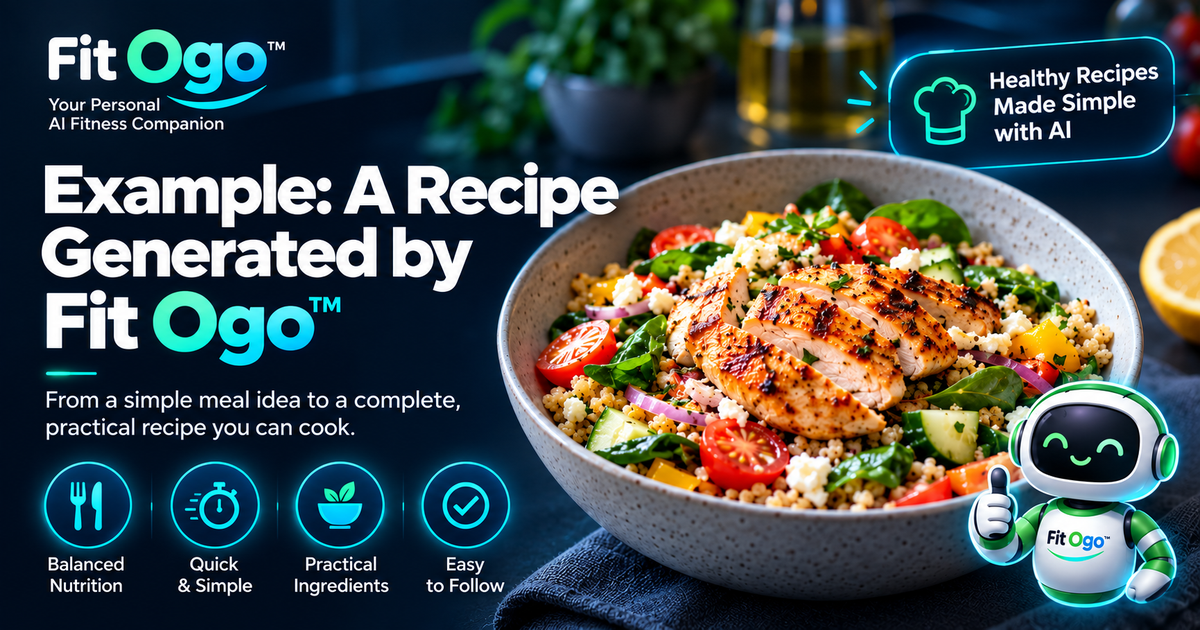
What does a Fit Ogo™ generated recipe actually look like? This article shows one real example produced from a defined set of Recipe Planner inputs.
The example is intended to demonstrate the structure and information returned by the Recipe Generator. It is not presented as a universal recipe recommendation or as individualized nutrition advice.
Below you can review the information supplied to Fit Ogo™, the generated recipe title and timing, the ingredient list, preparation steps, and the nutrition metadata returned with this example.
Before You Review the Example
Example generated output — review before use
This article reproduces one Fit Ogo™ Recipe Generator result created from the specific inputs shown below. Review any generated recipe against your own dietary needs, allergies, ingredient labels, cooking requirements, food-safety considerations, health circumstances, and relevant professional guidance before preparing or relying on it.
The Inputs Used for This Example
For this example, the Fit Ogo™ Recipe Generator was given the following recipe-planning information.
Internal account identifiers, request identifiers, timestamps, and other operational metadata are intentionally excluded because they are not relevant to the public product example.
- Meal type
- Lunch
- Cuisine
- Australian
- Diet supplied
- None specified
- Servings requested
- 2
- Calorie target
- 500 kcal
- Available time
- 30 minutes
- Ingredients to avoid
- None
- Allergens supplied
- None
- Cooking skill level
- Intermediate
The Ingredient Information Supplied
The available-ingredient field contained one complete meal description rather than a loose shopping list.
The supplied meal idea was:
- Grilled chicken breast salad with mixed greens, cherry tomatoes, cucumber, roasted sweet potato, and balsamic vinaigrette (Australian-style).
The Additional Recipe Note
The user-supplied note
The generator was asked: “Create a healthy lunch with above ingredients.” The word “healthy” is reproduced here as part of the supplied input; this article does not independently classify or medically evaluate the recipe as healthy.
The Generated Recipe
Fit Ogo™ returned the following structured recipe summary.
- Recipe title
- Australian Grilled Chicken, Sweet Potato and Balsamic Salad
- Servings
- 2
- Calories per serving
- 515 kcal
- Preparation time
- 8 minutes
- Cooking time
- 22 minutes
- Total time
- 30 minutes
- Cuisine
- Australian
- Diet
- None
Generated Recipe Summary
The generated summary described the result as a fresh lunch salad using grilled chicken breast, mixed greens, cherry tomatoes, cucumber, roasted sweet potato, and balsamic vinaigrette.
The output also noted that keeping the sweet-potato pieces small would help the recipe remain within the requested 30-minute preparation-and-cooking window.
The Generated Ingredient List
The recipe returned five ingredient lines. They are reproduced below as generated output rather than independently recommended quantities.
- 320 g chicken breast fillets, about 2 cm thick
- 400 g sweet potato, cut into 1.5 cm cubes
- 120 g mixed greens
- 120 g cherry tomatoes, halved, and 120 g cucumber, sliced
- 60 mL balsamic vinaigrette
The Generated Preparation Steps
The Recipe Generator returned six ordered preparation steps.
- 1. Preheat oven to 220 °C and spread sweet potato on a lined tray, avoiding crowding.
- 2. Roast sweet potato for 22 min, turning once, until tender and lightly browned.
- 3. Heat a grill pan over medium-high heat and cook chicken for 5–6 min per side, avoiding crowding.
- 4. Check chicken reaches 74 °C at the thickest part, then rest for 5 min before slicing.
- 5. Divide mixed greens, cherry tomatoes, cucumber and roasted sweet potato between bowls.
- 6. Top with sliced chicken and drizzle with balsamic vinaigrette.
Food-Safety Detail Included in the Output
The generated instructions included a chicken-temperature check
The generated recipe instructed the user to check that the chicken reaches 74 °C at the thickest part before resting and slicing it. This is reproduced as part of the generated output. Users should still apply appropriate food-handling practices and any food-safety guidance relevant to their circumstances.
Generated Nutrition Metadata
The Recipe Generator also returned the following nutrition values. They are shown as product-output evidence; this article does not independently calculate, validate, prescribe, or clinically interpret them.
- Calories per serving
- 515 kcal
- Protein
- 42 g
- Carbohydrate
- 45 g
- Fat
- 18 g
- Fiber
- 8 g
- Sodium
- 390 mg
How the Generated Calories Compared With the Input Target
The supplied calorie target was 500 kcal, while the generated output listed 515 kcal per serving.
That is a difference of 15 kcal from the supplied target. In this example, the generator returned a nearby estimate rather than adding an unrelated ingredient simply to force the recipe to exactly 500 kcal.
This is one reason calorie targets in a general recipe-planning tool should be treated as planning context rather than as exact clinical nutrition prescriptions.
How the Generated Timing Compared With the Input
The supplied time limit was 30 minutes.
The generated result listed 8 minutes of preparation time and 22 minutes of cooking time, producing a stated total time of exactly 30 minutes.
The recipe structure therefore reflected the requested time limit in this example.
What This Example Demonstrates
This example shows how a defined meal idea can become a more detailed recipe without changing the basic meal concept.
The supplied ingredients became measured ingredient quantities. The 30-minute constraint became a preparation-and-cooking sequence. The two-serving request became a two-serving recipe, and the cuisine selection remained Australian in the returned output.
The result also demonstrates that the generated recipe contains more than a recipe title: it includes servings, timing, ingredient quantities, ordered preparation steps, a food-temperature instruction, and generated nutrition metadata for review.
Why Your Fit Ogo™ Recipe May Look Different
This example should not be treated as the one recipe structure Fit Ogo™ always produces.
Changing the information provided to the Recipe Planner can change the recipe context and therefore the generated result.
- A different meal idea can produce a different recipe.
- Different available ingredients can change the ingredient quantities and preparation method.
- A different number of servings can change the required quantities.
- A different time limit can affect which preparation methods are practical.
- A different cuisine preference can change the style of the generated recipe.
- Dietary information, ingredients to avoid, and allergen information can change what requires exclusion or additional review.
- A different calorie target can change the planning context without guaranteeing an exact numerical result.
Review a Generated Recipe Before You Use It
A generated recipe should still be reviewed before preparation.
- Are all of the listed ingredients available to you?
- Does the recipe contain anything you intended to avoid?
- Have you independently checked ingredient labels and allergen information where relevant?
- Do the quantities appear practical for the number of servings?
- Are the cooking instructions clear and appropriate for your equipment?
- Can you complete the recipe within the available time?
- Have you checked applicable food-handling, cooking-temperature, storage, and cross-contact requirements?
- If you have medically required dietary restrictions or significant health concerns, does the recipe align with relevant professional guidance?
From a Weekly Meal Plan to Recipe Detail
This particular example also illustrates the connection between Fit Ogo™ Meal Planner and Recipe Planner.
The supplied ingredient description corresponds to the grilled chicken salad meal idea used in the earlier generated 7-day Meal Planner example. Recipe Planner adds another level of detail by turning that meal idea into ingredient quantities and preparation steps.
The two tools therefore support different parts of the planning process: Meal Planner can organize the week, while Recipe Planner can provide more detail for an individual meal.
Create a Recipe Around Your Own Inputs
The value of this example is not that every user should prepare the same chicken-and-sweet-potato salad.
It demonstrates how Fit Ogo™ can organize supported information such as meal type, cuisine, available ingredients, serving count, available time, calorie context, cooking experience, and additional notes into a structured recipe for review.
Your own generated recipe can reflect the information you provide rather than requiring you to copy this example.
Fit Ogo™ Recipe Planner
Create a Recipe Around Your Own Inputs
Provide supported recipe information such as your meal idea, ingredients, servings, cuisine, available time, dietary information, and other supported context, then review the structured recipe generated by Fit Ogo™.
Explore the Fit Ogo™ Recipe PlannerExplore Related Fit Ogo™ Guides & Tools
How to Turn a Meal Idea Into a Practical Recipe
Learn the planning steps that can help turn a meal idea into ingredients and preparation structure.
Example: A 7-Day Meal Plan Generated by Fit Ogo™
See the weekly Meal Planner example that contains the grilled chicken salad meal used as the starting point for this recipe example.
Read the Fit Ogo™ Health Disclaimer
Review the nutrition and wellness-education boundary that applies across Fit Ogo™.
Fitness & wellness education only. Fit Ogo™ provides general fitness, nutrition, habit, meditation, and wellness education and planning support only. It does not provide medical advice, diagnosis, treatment, or individualized clinical nutrition care. The ingredient quantities, calorie value, nutrition metadata, cooking times, and preparation instructions shown in this article are generated example output, not recommendations for another person. Review generated recipes against your own dietary needs, allergies, ingredient labels, food-safety requirements, health circumstances, equipment, and relevant professional guidance.