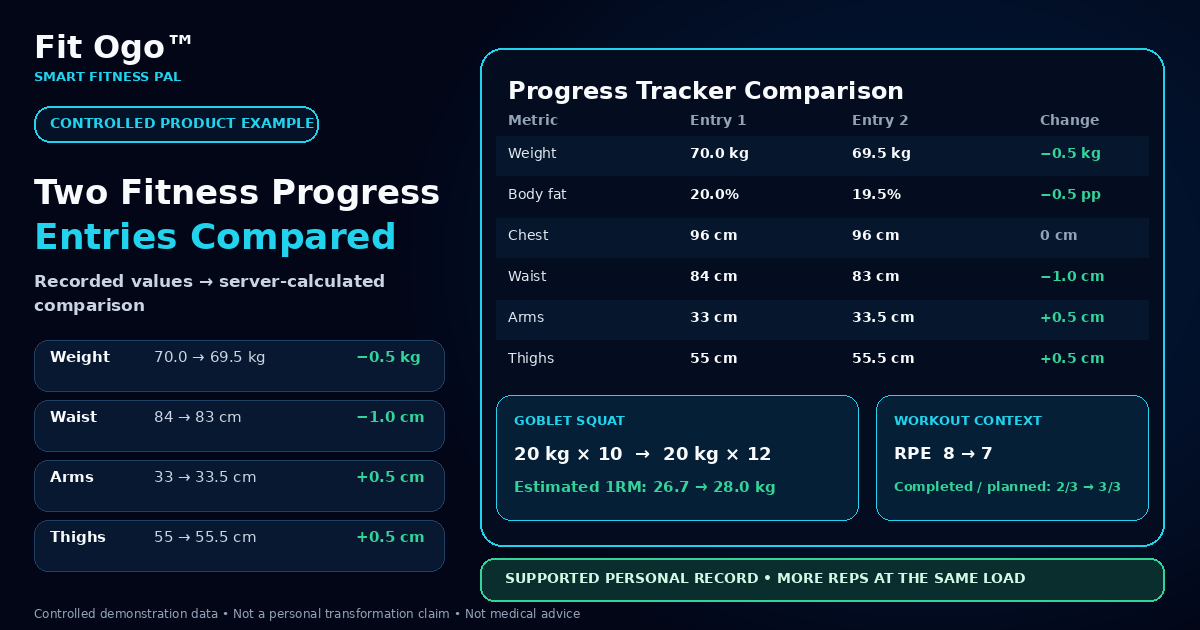
What does a Fit Ogo™ Progress Tracker comparison actually look like? This article uses two controlled demonstration entries to show how recorded fitness information becomes a structured comparison.
The example is not presented as a real person’s transformation and does not claim that Fit Ogo™ caused any of the differences shown.
The product workflow is straightforward: record the entry, save it, compare it with the previous record, calculate supported metrics, then review the result.
Before You Review the Example
Controlled demonstration data — not a personal transformation claim
The figures in this article are a controlled test dataset selected to demonstrate Fit Ogo™ Progress Tracker behaviour. They are not another person’s fitness results, medical measurements, recommendations, or guarantees of outcomes.
Entry 1 — The Baseline Record
The first controlled entry establishes the baseline used by the comparison. One entry is a snapshot; it does not yet show a trend.
- Weight
- 70.0 kg
- Body fat entered
- 20.0%
- Chest
- 96 cm
- Waist
- 84 cm
- Hips
- 98 cm
- Arms
- 33 cm
- Thighs
- 55 cm
- Strength
- Goblet Squat — 20 kg × 10 reps
- Estimated 1RM
- 26.7 kg
- Session RPE
- 8
- Workout adherence input
- 3 planned / 2 completed
- Note
- Felt controlled.
Entry 2 — The Comparison Record
The second controlled entry uses the same supported fields so Fit Ogo™ can compare like with like against the previous record.
- Weight
- 69.5 kg
- Body fat entered
- 19.5%
- Chest
- 96 cm
- Waist
- 83 cm
- Hips
- 98 cm
- Arms
- 33.5 cm
- Thighs
- 55.5 cm
- Strength
- Goblet Squat — 20 kg × 12 reps
- Estimated 1RM
- 28.0 kg
- Session RPE
- 7
- Workout adherence input
- 3 planned / 3 completed
- Note
- Set felt controlled.
What the Server-Calculated Comparison Shows
The deterministic comparison reports what changed in the recorded data. It does not attempt to explain why the changes occurred.
- Weight change
- −0.5 kg
- Body-fat change
- −0.5 percentage points
- Chest change
- 0 cm
- Waist change
- −1.0 cm
- Hips change
- 0 cm
- Arms change
- +0.5 cm
- Thighs change
- +0.5 cm
Strength Comparison — 20 kg × 10 to 20 kg × 12
The same exercise appears in both entries: Goblet Squat.
The load remained at 20 kg while the recorded repetitions increased from 10 to 12. That creates a direct like-for-like performance comparison inside the controlled example.
How Estimated 1RM Changes in This Example
Fit Ogo™ calculates estimated 1RM from recorded load and repetitions using the current server formula: weight × (1 + reps / 30).
For Entry 1, 20 × (1 + 10/30) = 26.7 kg after rounding. For Entry 2, 20 × (1 + 12/30) = 28.0 kg.
The controlled comparison therefore shows an estimated 1RM change of +1.3 kg. Estimated 1RM is a fitness estimate rather than a direct one-repetition test or medical measurement.
Why a Supported Personal Record Is Identified
Supported personal record — Goblet Squat
The same 20 kg load was recorded for more repetitions in Entry 2, and estimated 1RM also increased from 26.7 kg to 28.0 kg. The product can therefore identify a supported personal-record change for this matching exercise.
Workout Effort Adds Context
Session RPE changed from 8 in Entry 1 to 7 in Entry 2.
That is recorded workout context. It should not be used by itself to conclude that fitness improved or to explain why any other metric changed.
Adherence Adds Another Dimension
The controlled example records planned and completed workouts so adherence can be calculated alongside physical and performance data.
- Entry 1
- 2 completed / 3 planned = 66.7%
- Entry 2
- 3 completed / 3 planned = 100%
- Change
- +33.3 percentage points
Notes Preserve Context Without Replacing the Metrics
Entry 1 records “Felt controlled.” Entry 2 records “Set felt controlled.”
These notes preserve short contextual information, but the numerical comparison remains based on the recorded values and server calculations.
Deterministic Metrics Come Before Optional AI Interpretation
Fit Ogo™ keeps canonical progress data and deterministic calculations separate from optional AI interpretation.
Progress entries are saved and server-calculated metrics are established first. Optional analysis can then interpret the recorded changes, but it does not replace the underlying progress record as authority.
What This Example Does Not Prove
This comparison shows recorded differences. It does not establish the physiological cause of those differences.
- The 0.5 kg weight difference does not by itself prove fat loss.
- The 1 cm waist difference does not prove why the measurement changed.
- The estimated 1RM increase does not prove that a particular workout program caused it.
- The lower RPE does not prove improved fitness.
- The adherence difference does not prove that it caused any other recorded change.
Why Your Own Progress Comparison May Look Different
Different users can record different combinations of supported information. Some entries may contain weight but no body-fat value, measurements but no strength set, several strength exercises, additional conditioning information, or different workout context.
Fit Ogo™ compares the supported information that is actually present rather than forcing every progress entry to contain the same fields.
Two Entries Create a Comparison — More Entries Create a Broader Record
Two entries are enough to compare one point in time with another. Repeated entries can make broader patterns easier to review.
The purpose is not to turn every small difference into a conclusion. It is to maintain a progress record where recorded values, calculated changes, and later interpretation remain distinguishable.
Fit Ogo™ Progress Tracker
Create Your Own Progress Record
Record supported fitness progress information, compare entries over time, and review server-calculated changes in measurements, strength performance, workout context and consistency.
Explore the Fit Ogo™ Progress TrackerExplore Related Fit Ogo™ Guides & Tools
How to Track Fitness Progress Beyond the Scale
Learn how to build a broader fitness progress record using measurements, strength performance, workout context, adherence, and repeated entries.
How to Build a Workout Routine Around Your Schedule
Build a practical workout structure that can provide useful context for the progress information you record.
Read the Fit Ogo™ Health Disclaimer
Review the fitness and wellness-education boundary that applies across Fit Ogo™.
Fitness & wellness education only. Fit Ogo™ provides general fitness, nutrition, habit, meditation, and wellness education and tracking support only. This article uses controlled demonstration data to show how Progress Tracker processes supported entries. The values are not personal fitness results, medical measurements, recommendations, or guarantees of outcomes. Weight, body-fat information, measurements, adherence, estimated 1RM, personal records, calculated changes, and optional analyses are fitness-tracking information, not medical assessments. Recorded differences do not establish why a change occurred. Follow relevant professional guidance where applicable.