A habit routine becomes more useful when the behaviour you want to repeat is clear enough to recognize, practical enough to fit your real schedule, and simple enough to record.
That does not mean every part of your day needs to become a tracked habit. A useful habit routine can begin with only one or two actions that matter to the fitness or wellness routine you have chosen.
The aim is not to build the longest streak possible or create a perfect calendar. It is to create a routine you can understand, record, and review over time.
Start With a Behaviour You Can Clearly Identify
A habit is easier to track when you can tell whether it happened.
“Be healthier” may describe an intention, but it is difficult to record as a daily action. A clearer habit describes something you can recognize and record.
- Complete the scheduled workout.
- Take a 30-minute walk.
- Complete a planned mobility session.
- Take a short mindfulness break.
- Review tomorrow’s workout plan.
Choose Daily or Weekly Frequency Based on the Routine
Not every useful habit needs to happen every day.
A walking habit may make sense daily for one person, while a workout habit may only apply on selected training days. The goal is not to make the schedule look ambitious; it is to describe the routine you actually intend to follow.
Choose the Days Before You Start Counting Consistency
If a habit is only intended for certain days, define those days first.
For example, someone following a Monday, Wednesday and Friday workout plan might create a workout habit that applies only on those days. That is more meaningful than treating other days as failures for something that was never scheduled to happen.
Use Timing When It Helps — Not Because Every Habit Needs a Clock
Some habits benefit from a time. A morning walk, evening mobility session, or scheduled meditation may be easier to remember when linked to a particular part of the day.
Other habits may only need the correct day. The purpose of timing is to provide useful routine context, not to create unnecessary rigidity.
Keep the First Version of the Routine Simple
Tracking becomes harder when the system contains more habits than you can realistically pay attention to.
Start with the routines that matter most. A smaller routine gives you clearer information about whether the structure fits your week. More habits do not automatically mean better tracking.
Record the Check-In When the Habit Is Actually Completed
A habit tracker becomes useful through the record you create. When you complete an action that is due, record the check-in.
Do not record a future completion simply because you expect to do it later. The purpose of the record is to reflect what actually happened.
Treat Streaks as Information, Not a Score of Your Character
Streaks can help show continuity, but a streak is only one measure. Breaking a streak does not automatically mean the entire routine has failed.
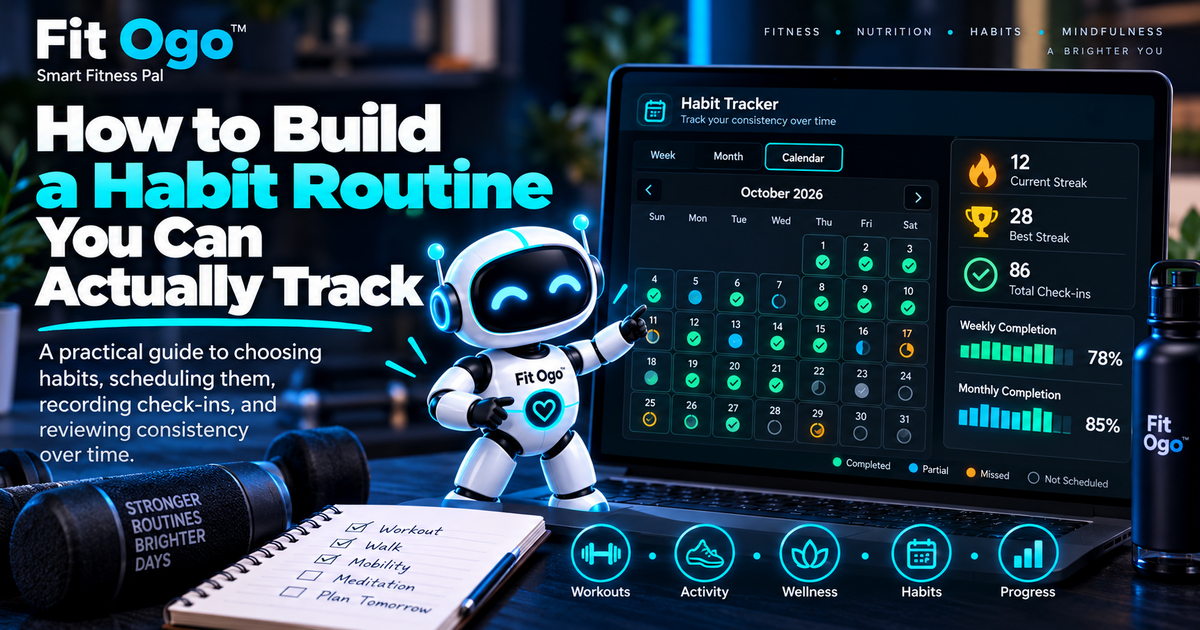
A broader review can include the current streak, previous best streak, total check-ins, weekly completion, monthly completion, and the pattern visible across the calendar.
Review the Current Week Without Penalizing Days That Have Not Happened Yet
When reviewing an active week, future scheduled days should not automatically count as missed activity.
If it is Tuesday and a habit is also scheduled for Friday, Friday has not failed. It simply has not happened yet. Fit Ogo™ applies this principle by evaluating the current week and current month only through today rather than treating future dates as expected failures.
- Completed — the scheduled action was recorded as completed.
- Missed — an expected date has passed without the supported completion record.
- Not yet due — the scheduled date is still in the future.
Use a Calendar to Look for Patterns
A calendar can make habit history easier to understand because it places individual check-ins in time.
Instead of focusing only on a single streak number, look for patterns in which days are easier or harder to complete, whether the schedule is realistic, and whether consistency changes over several weeks.
Review the Routine, Not Just the Person
When a habit is repeatedly missed, the routine itself may need review.
- Is the habit clearly defined?
- Is it scheduled too often?
- Does it fit the days you actually have available?
- Is the timing realistic?
- Are you tracking too many things?
- Has your routine changed?
Connect Habits With an Existing Workout Routine
Habit tracking can be particularly useful when another part of the routine already has structure.
If you already have a workout plan with Monday, Wednesday and Friday training days, you can manually create a habit around those workout days. You might also choose to track a walking habit on selected non-training days.
Fit Ogo™ does not automatically decide which habits should be created from your workout plan. The current workflow keeps that decision under the user’s control.
Do Not Turn Every Wellness Activity Into an Obligation
Tracking can be useful, but not every positive activity needs a checkbox.
The purpose of habit tracking is to help you record the routines you choose, not to make everyday wellness feel like an endless list of tasks. Use the tracker where visibility is useful and leave unnecessary tracking out.
Using the Fit Ogo™ Habit Tracker
Fit Ogo™ Habit Tracker gives you a structured place to create supported fitness and wellness habits, record your own check-ins, and review consistency.
The current workflow allows you to choose habits yourself, add routine context, record completion, and review your activity over time. It can derive broader consistency information such as active streaks, best streaks, total check-ins, and current weekly and monthly statistics.
Fit Ogo™ Habit Tracker is a tracking tool. It does not diagnose motivation, behaviour, mental-health conditions, or medical conditions.
Build a Routine You Can Review
The strongest habit routine is not necessarily the one with the most habits. It is the one where you understand what you are tracking, when it is expected, whether you completed it, and what the record shows over time.
Start with a clear behaviour. Choose a realistic frequency. Record the check-ins. Review the pattern. Then adjust the routine if your real life tells you that the structure needs to change.
Fit Ogo™ Habit Tracker
Create Habits You Can Track and Review
Create supported everyday fitness and wellness habits, record your own check-ins, and review consistency across your routine with Fit Ogo™ Habit Tracker.
Explore the Fit Ogo™ Habit TrackerExplore Related Fit Ogo™ Guides & Tools
How to Build a Workout Routine Around Your Schedule
Build a practical workout structure that can provide context for workout-day and rest-day habits.
Track Your Fitness Progress
Record and compare supported fitness progress information over time with Fit Ogo™.
Read the Fit Ogo™ Health Disclaimer
Review the fitness, wellness, and behavioural-health boundary that applies across Fit Ogo™.
Fitness & wellness education only. Fit Ogo™ provides general fitness, nutrition, habit, meditation, and wellness education and tracking support only. It does not provide medical advice, diagnosis, treatment, psychological treatment, or behavioural-health treatment. Habit records, streaks, check-ins, and consistency statistics are tracking information, not assessments of motivation, mental health, or medical status. Choose routines appropriate to your circumstances and follow relevant professional guidance where applicable.